
Color consistency is one of the most important quality requirements in the printing and packaging industry. A small variation between an approved color standard and a finished product can affect brand identity, product appearance, customer satisfaction, and production costs. For this reason, reliable color measurement has become an essential part of professional quality control.
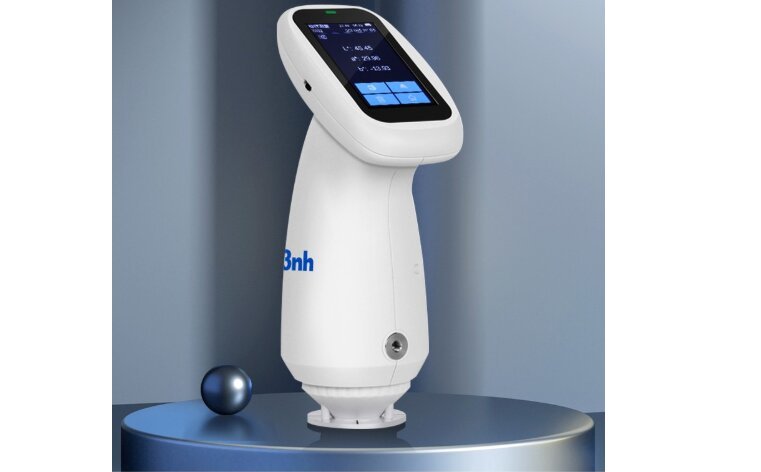
The Printing Spectrocolorimeter PS2040 provides a compact and practical solution for measuring color differences with high precision. Designed as a portable spectrocolorimeter, the PS2040 combines advanced optical technology, multiple measurement modes, automatic calibration, and a convenient touchscreen interface in a handheld instrument.
We can use the PS2040 across a wide range of applications, including printing, packaging, publishing, plastics, electronics, paint, ink, textiles, garments, and ceramics. Its combination of portability and measurement performance makes it particularly useful where color decisions need to be made quickly and consistently.
What Is the Printing Spectrocolorimeter PS2040?
The Printing Spectrocolorimeter PS2040 is a compact handheld instrument developed for professional color measurement and color difference analysis. Rather than relying on visual inspection alone, we can use the instrument to obtain objective numerical color data from a sample.
The PS2040 is designed around a D/8 optical structure and supports both SCI and SCE measurement modes. These capabilities allow us to evaluate color under different measurement conditions and obtain more useful information when working with materials that have varying surface characteristics.
Its 400–700 nm full-waveband balanced LED illumination and CMOS dual-beam splitting sensor provide the optical foundation for stable color measurement.
PS2040 Spectrocolorimeter for Printing Quality Control
Printing involves numerous variables, including ink formulation, paper or substrate characteristics, press conditions, drying, coating, and environmental factors. Even when a printed product appears correct to the human eye, measurable differences can still exist.
The PS2040 Spectrocolorimeter gives printing professionals a numerical method for evaluating those differences. Instead of depending exclusively on subjective visual comparisons, we can compare measured results against an established color standard.
This approach can be particularly valuable when reproducing corporate colors, packaging artwork, labels, commercial publications, and other products where color consistency is important.
Why Accurate Color Measurement Matters in Printing
Color accuracy affects much more than the appearance of an individual printed sheet. For brands, consistent colors are closely connected with recognition and visual identity. A logo or packaging design that changes noticeably between production batches may create an inconsistent customer experience.
With an objective color measurement system, we can:
- Compare production samples with approved standards.
- Detect color differences during manufacturing.
- Reduce reliance on subjective visual inspection.
- Support more consistent production between batches.
- Identify problems before large quantities are completed.
- Improve communication between designers, printers, suppliers, and quality teams.
- Maintain documented color-quality records.
The PS2040 therefore serves as a practical tool for incorporating measurable color control into everyday production processes.
D/8 Optical Structure and SCI/SCE Measurement
One of the important technical characteristics of the PS2040 is its D/8 optical geometry. This type of optical configuration is widely associated with professional color measurement because it allows measurements to account for the interaction between illumination, sample surface, and observation conditions.
The instrument also supports SCI (Specular Component Included) and SCE (Specular Component Excluded) measurement modes.
SCI can be useful when we want to evaluate color while including the specular reflection from a surface. SCE, on the other hand, excludes the specular component and can provide information that is more closely related to the visual appearance of certain surfaces.
Having both options gives quality-control teams greater flexibility when measuring different materials and finishes.
400–700 nm Full-Waveband Balanced LED Light Source
The PS2040 uses a 400–700 nm full-waveband balanced LED light source. This provides illumination across the visible spectrum used for color measurement.
A balanced light source is important because color measurement depends on the interaction between the light illuminating a sample and the sample’s spectral response. By using a controlled illumination system, we can obtain more consistent measurement conditions than would normally be possible with uncontrolled ambient lighting.
This is especially useful in manufacturing environments where visual lighting conditions can vary throughout the day.
CMOS Dual Beam-Splitting Sensor Technology
The CMOS dual beam-splitting sensor is another significant component of the PS2040. The sensor system is designed to support stable spectral measurements while keeping the instrument compact and portable.
For production environments, repeatability is essential. If the same sample is measured repeatedly under controlled conditions, the results should remain sufficiently consistent to support dependable quality decisions.
The PS2040 is specified with repeatability of ΔEab ≤0.35 and inter-instrument agreement of ΔEab ≤0.35, supporting its use in professional color-difference applications where measurement consistency matters.
Automatic Whiteboard Calibration
Regular calibration is fundamental to reliable color measurement. The PS2040 includes automatic whiteboard calibration, making the calibration process more convenient for users.
A straightforward calibration workflow can help operators maintain consistent measurement conditions throughout routine production. This is particularly valuable when the instrument is used frequently for quality inspections across different samples and production runs.
By incorporating calibration into the measurement workflow, we can reduce unnecessary complexity for operators while supporting dependable color data.
Double Aperture for Different Sample Types
Different materials and sample shapes can require different measurement approaches. The PS2040 is equipped with Φ4 mm and Φ5 mm apertures, including flat and tip configurations.
This double-aperture design provides greater flexibility when measuring products with different dimensions, surfaces, and geometries.
For example, a quality-control operator may need to measure a relatively flat printed surface in one application and a smaller or more challenging sample in another. Having different aperture options allows the same instrument to accommodate a wider range of measurement tasks.
PS2040 as a 4-Color Printing Color Difference Meter
The PS2040 can be used as a 4-color printing color difference meter, making it relevant to professional printing and color-control workflows.
Four-color printing commonly involves cyan, magenta, yellow, and black inks, and maintaining appropriate color relationships is essential for accurate reproduction. Color difference measurement can help identify variations that occur during production and provide numerical information for quality-control decisions.
Rather than evaluating only the final appearance, we can use measured color data to establish a more systematic quality-control process.
Pantone Chart and Multiple Color Spaces
Modern color workflows often involve different color standards and measurement systems. The PS2040 supports multiple color measurement spaces and includes an integrated Pantone chart.
This functionality can simplify certain color comparison tasks by allowing operators to work with recognized color references directly through the instrument.
Supporting multiple color spaces is also useful when different teams or production stages rely on different methods of describing color. A flexible measurement system can make communication easier between design, manufacturing, quality assurance, and procurement teams.
UV Light Source for Fluorescent Materials
Some materials contain fluorescent components that respond differently under ultraviolet illumination. The PS2040 includes a UV light source, allowing it to measure fluorescent materials.
This can be useful in applications involving specialized papers, textiles, coatings, optical brighteners, and other materials where fluorescence can influence perceived color.
Including UV capability extends the practical application range of the instrument beyond conventional non-fluorescent samples.
2.8-Inch TFT Capacitive Touch Screen
The PS2040 features a 2.8-inch TFT capacitive touchscreen, providing a modern interface for accessing measurement functions and viewing results.
For handheld equipment, usability is important because operators may perform many measurements during a production shift. A touchscreen interface can make navigation more intuitive and provide clear access to measurement information.
Its compact design also means the instrument can be transported easily between production areas, laboratories, inspection stations, and supplier locations.
Applications of the PS2040 Spectrocolorimeter
The versatility of the PS2040 Spectrocolorimeter makes it suitable for several industries.
· Printing and Publishing
Printers can use the instrument to evaluate printed colors, compare production samples with standards, and monitor color consistency during manufacturing.
· Packaging
Packaging companies can use objective color measurement to maintain consistent brand colors across boxes, labels, flexible packaging, and other printed materials.
· Paint and Ink
Color measurement can help manufacturers evaluate formulations and identify differences between samples and established references.
· Plastics and Electronics
Plastic components and electronic housings often require consistent colors across production batches. The PS2040 provides a convenient method for checking those colors.
· Textiles and Garments
The instrument can also support color quality control for textiles and garments, where differences between fabrics, batches, and dye lots can be important.
· Ceramics
Ceramic manufacturers can use color measurement to monitor finished surfaces and maintain consistency across production.
Software for Color Quality Management
The PS2040 can be paired with quality management software to facilitate color monitoring and data management.
Digital measurement records can make it easier to organize results, monitor production quality, and review historical data. For businesses handling large numbers of samples, structured color information can be considerably more useful than relying on handwritten visual inspection notes.
A connected quality-management approach can also support communication between production and quality-control departments.
Portable Design for On-Site Color Inspection
A major advantage of the PS2040 is its portable handheld design. Traditional laboratory-based measurement systems can be highly capable, but they may not always be convenient when color needs to be checked directly at the production line.
A portable spectrocolorimeter allows us to take the measurement equipment to the sample instead of always moving samples to a laboratory.
This can make inspection faster and more practical for manufacturing environments, supplier inspections, incoming-material checks, and production-floor troubleshooting.
Benefits of Using the Printing Spectrocolorimeter PS2040
The PS2040 combines several features that are valuable for modern color-control operations:
- High measurement precision
- Portable handheld construction
- D/8 optical geometry
- SCI and SCE measurement modes
- 400–700 nm balanced LED illumination
- CMOS dual beam-splitting sensor
- Automatic whiteboard calibration
- Multiple color spaces
- Built-in Pantone chart
- UV measurement capability
- Dual Φ4 mm / Φ5 mm apertures
- 8-inch TFT capacitive touchscreen
- Color quality-management software support
- Application across multiple manufacturing industries
Together, these features make the PS2040 a practical choice for businesses that need reliable and repeatable color measurement without sacrificing portability.
How the PS2040 Supports Better Production Decisions
Color measurement becomes especially valuable when it is integrated into a broader quality-control process. We can establish reference standards, measure production samples, identify deviations, and use the resulting data to determine whether corrective action is required.
This can help move color inspection from a subjective process toward a data-driven quality-control workflow.
For printing companies, this may mean identifying color variation before an entire production run is completed. For packaging manufacturers, it can mean maintaining consistency across different batches or substrates. For textile and plastics manufacturers, it can provide objective information when visual comparisons are insufficient.
Choosing a Professional Color Difference Measurement Instrument
When selecting a spectrocolorimeter, we should consider more than basic color measurement. Optical geometry, repeatability, measurement aperture, calibration, software capabilities, measurement modes, sample compatibility, and portability can all affect how effectively an instrument fits into a production environment.
The PS2040 addresses these requirements through its combination of spectral measurement technology, portable construction, flexible apertures, SCI/SCE functionality, UV capability, automatic calibration, and quality-management support.
This makes it suitable for organizations that require color measurement across multiple stages of production rather than only occasional laboratory testing.
Conclusion
Consistent color is essential across modern printing, packaging, publishing, textiles, plastics, paint, ink, electronics, and ceramics. Visual inspection alone can be difficult to standardize, particularly when production volumes increase or different operators evaluate the same samples.
The Printing Spectrocolorimeter PS2040 provides a compact, high-precision solution for objective color measurement. Its D/8 optical structure, SCI/SCE modes, balanced 400–700 nm LED source, CMOS dual beam-splitting sensor, automatic whiteboard calibration, dual apertures, UV capability, multiple color spaces, built-in Pantone chart, and touchscreen interface make it a versatile instrument for professional color-control applications.
By incorporating the PS2040 Spectrocolorimeter into a structured quality-management process, we can measure color differences more consistently, monitor production quality, and make informed decisions based on objective measurement data. For businesses where accurate color reproduction is directly connected to product quality and customer expectations, dependable spectrocolorimetric measurement can become an important part of maintaining a reliable manufacturing standard.